If you’ve heard of momentum investing, you’ve probably run into the ticker MTUM. It’s BlackRock’s iShares MSCI USA Momentum Factor ETF, and it’s one of the biggest momentum funds in the world.
In this video I’ll explain what MTUM actually holds, how it picks its stocks, and how it compares with a concentrated version of the same idea, which is what we built at Strike Algo.
I’m not here to tell you MTUM is bad. It’s a solid fund. I want you to understand what you’d be buying, and which version of momentum fits what you’re trying to do.
Momentum, packaged as one fund
So what is MTUM? It’s an ETF, which means you buy it like a stock at any broker. It holds about 125 U.S. stocks, and as of October 2026 it had about 20 billion dollars in it.
It follows an index from MSCI that scores stocks by how strongly they’ve been rising, and then weights them. When the index rebalances, the fund follows.
The idea is the same one behind Strike: stocks that have been winning tend to keep winning for a while. That’s been published research since 1993. The difference is how wide or how focused you go. MTUM goes wide. It owns a lot of names so it’s broader and steadier. That’s exactly why a 20-billion-dollar fund can run it.
Want the focused version, running in an account in your own name?Book a call →Hear it from people who use Strike Same idea, different focus
Here’s the comparison side by side.
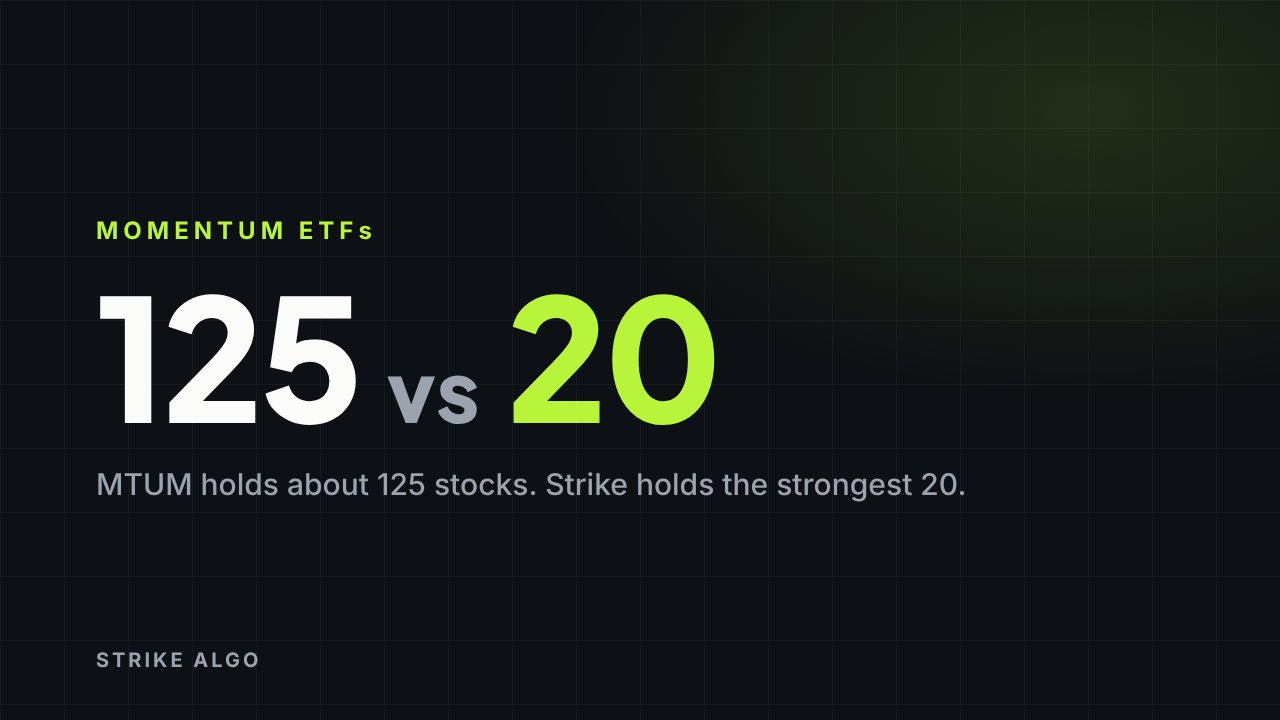
MTUM owns about 125 stocks. Strike owns only the top 20. MTUM follows an index. Strike ranks about 450 of the most liquid U.S. stocks every single day and rotates the portfolio once a month.
MTUM is an ETF, so it sits wherever you buy it. Strike is software that runs inside your own Interactive Brokers account, in your name.
And here’s the real trade-off. Owning 125 stocks makes MTUM broader and steadier. Owning 20 puts you in the strongest names, where the momentum effect is most concentrated, but it means bigger swings, up and down. Neither one is wrong. They’re built for different people.
Over the same months
Now the numbers over the same months. Say you put 100,000 dollars in at the start of April 2020 and checked it on September 30, 2026.
In the S&P 500, it would be worth about 315,800 dollars. In BlackRock’s MTUM, about 318,300. On the Strike model record, about one million, fifty-five thousand dollars.
That’s the power of concentrating in the strongest 20 names. But remember the other side of it. That same concentration is why Strike’s deepest drawdown was 37 percent, and why it had a minus 22 percent month in July 2026. More upside has come with bigger swings.
These are model results before fees and costs, not a client account, and past performance doesn’t guarantee future results.
Broad or focused? See which fits you.
So here’s how I’d think about it. If you want broad, steady momentum exposure with no setup, MTUM is a strong fund. If you want the concentrated version, in your own account, and you can sit through bigger swings, that’s what Strike is built for.
You can see the full side-by-side on our website at strikealgo.net, and if you want to talk it through, book a call. We’ll show you the record and the platform live.
Why this matters if you’re considering Strike
If MTUM fits you, buy MTUM. It’s a solid fund. But if you want the strongest 20 names instead of 125, with every trade visible in an account you own, that’s exactly what Strike was built for. On a call we’ll put the two side by side against your goals and your appetite for swings.
What happens on your call1We open the record togetherThe verified report, every month, the good and the bad. Ask anything.
2We map it to your accountHow Strike would run in your own Interactive Brokers account, the minimum, and what the swings could feel like.
3You decidePaper trade first if you like. No pressure, and if it isn’t a fit, we’ll tell you.
$100,000, same months
Jegadeesh & Titman 1993George & Hwang 2004Moskowitz, Ooi & Pedersen 2012
$100,000 invested April 2020, value September 30, 2026. MTUM NAV total returns per BlackRock. Strike: verified model record, gross of fees. Same months.

 Click to watch the video3:23 · Turn your sound on 🔊